The Shoelace Diploma
Published on
What do you do when you realise you missed some of the ordinary things everyone else seems to know? Starting with efficiently tying your shoelace?
It was the fourth time I’d had to tie my shoelace in the barely three hours since I left my house. Frustration had me cursing at my shoe, mostly because it was better to be mad at it than at myself. Still, it got me thinking about my inadequacies, particularly the minuscule things I’m grossly incompetent at.
Earlier that morning, I had watched Daan tie his shoelace most fascinatingly. I’d probably need to watch YouTube videos on repeat and practice for two months to pull off anything that good, so of course I complimented him on it.
He barely looked up as he tied the other shoe. With that smile in his voice he always seems to have, he asked, “What do you mean? You mean you never learned how to tie your shoelaces like this?”
I said no. I offered a half-shrug and replied, “I’m really great and amazing (I know, I compliment myself a lot, because if I don’t, who will?) at a lot of things, but I’m just unable to tie my shoelaces decently.”
He said, “This is the first diploma you get in school. Tying your shoelaces.”
Of course, I thought he was joking. But after he left, I Googled it and found out that it was, in fact, a real thing. The Dutch have a shoelace diploma, or a Veterstrikdiploma, which children can receive after learning how to tie their shoelaces. And, as you must have guessed by now, I never got one.
No one taught me how to tie my shoelaces as a child, either at school or at home. I suppose we all thought it was an intrinsic ability you learn through repetition. Except I never learned, despite having had more than twenty-five years of opportunities to figure it out.
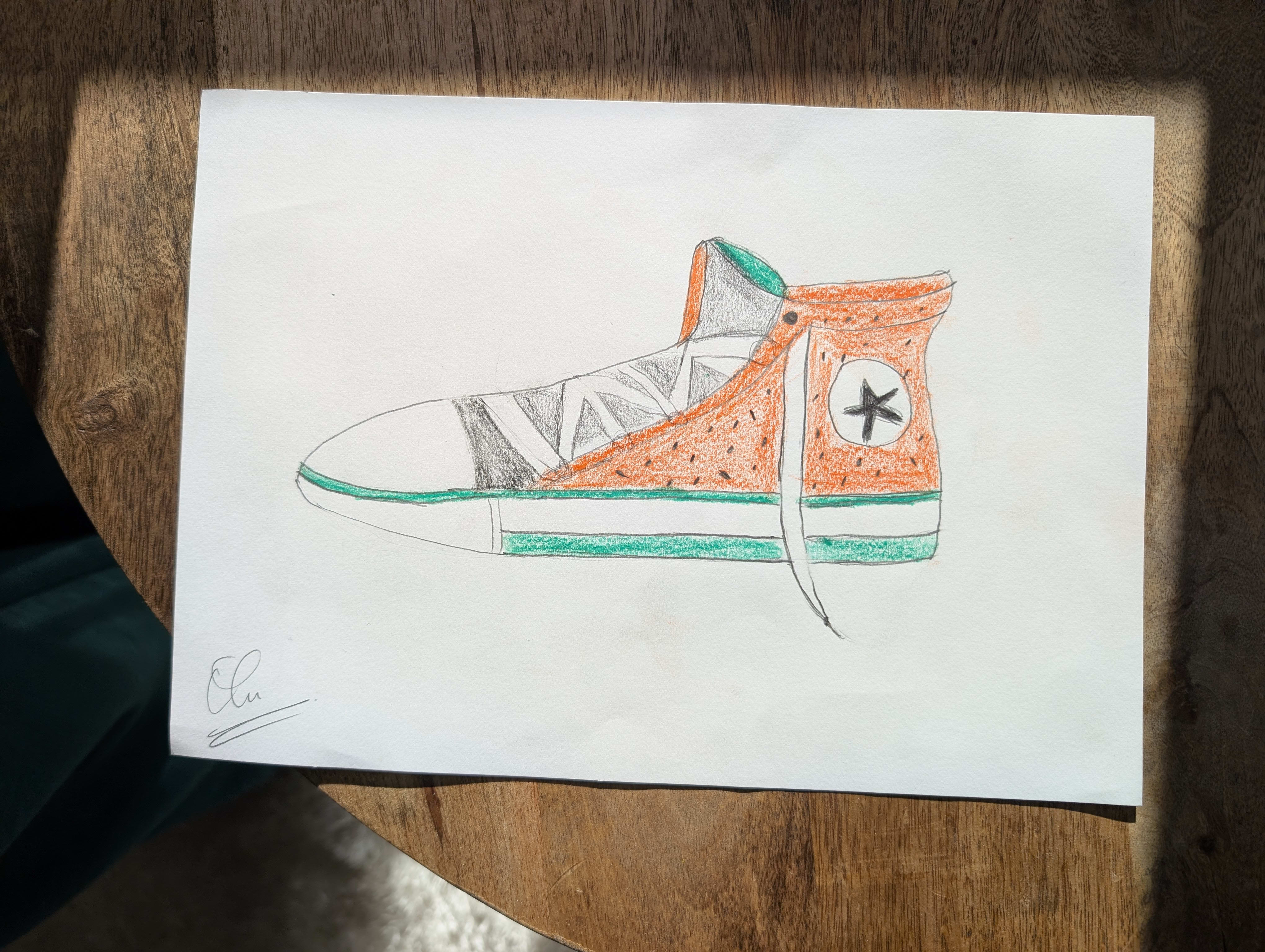
My draw la-la submission. Apparently, I am also not the best at drawing an untied shoelace
That realization sent me down the path of mentally auditing my life skills. I started taking inventory of the foundational, sometimes even survival, skills that everyone else seems to possess and I somehow missed. I am usually the first person to say that comparison is the thief of joy, so I want to be clear that I am not comparing my life to anyone else’s. What a waste of time that would be. I was merely taking stock.
I started with swimming, partly because it has become much more important to me since moving to the Netherlands, and it doesn’t exactly build confidence to keep being told that, should the country get flooded, I’ll be one of the first to die. I never learned how to swim, which is ironic considering I grew up surrounded by water. Yet swimming wasn’t something anyone prioritized or considered essential to our upbringing.
Once I started thinking about swimming, I started thinking about all the other things I had never learned or experienced simply because no one around me thought they were particularly important.
This ongoing audit led me to think about Jude in Hanya Yanagihara’s A Little Life and his private awareness of all the seemingly ordinary things he never experienced.
Jude is brilliant. He knows French and German, and large parts of the Bible almost by memory. He knows how to help birth a calf, rewire a lamp, identify poisonous mushrooms, unclog a drain, harvest a walnut tree and bale hay. He knows how to tell whether a watermelon is fresh simply by thunking it in the right place. He knows an astonishing number of things. And yet, he is constantly reminded of all the things he does not know.
He has never watched the sitcoms his classmates casually reference. He has never been to a movie. He has never gone on vacation or to summer camp. Jude’s classmates talked about their childhoods as though they were recounting a shared history. They talk about curfews and punishments (I’m not in short supply of those, actually), embarrassing clothes (again, no shortage of those), family holidays, broken bones (does one experience count?), first kisses and first sex. They talk about the stupid decisions they made as teenagers and the stories they accumulated along the way.
Jude mostly listens, not because he lacks the intellectual capacity. In fact, the author paints him as the smartest and most versatile of his friend group. Rather, he lacks the ordinary experiences that let you recognize yourself in other people, which is often what we all crave most.
So, like Jude, I know an extraordinary amount (I won’t bore you with examples). Yet I feel the distance between myself and everyone else whenever they casually refer to something completely foreign to me.
That said, it would be callous of me to equate my circumstances with Jude’s. His circumstances are profoundly different from mine. The comparison I’m making is much smaller.
I first noticed this properly when I got to university for my undergraduate degree and met people from different walks of life, which in Nigeria mostly meant people from different parts of the country. I found myself doing what Jude did. I listened as they talked and talked because I didn’t have the story they wanted.
I have stories, of course. If you want to know how I managed studying while looking after my two younger brothers, I have stories for days. If you want to know how I stayed back after school near the physics laboratories just to read before going home, I can tell you about that too. But those did not feel like the stories anyone wanted to hear when they were reminiscing about being young. My stories sounded less like a typical teenage childhood and more like the life of a single mother of three living hand-to-mouth while trying to get through school.
So, I learned to listen and ask good follow-up questions. I did this partly because I found people interesting and recognized that people love talking about themselves, but mostly because I did not have the stories they needed. And if you ask good questions, you do not have to answer quite so many of your own. It was a useful skill. It meant I could be interested in other people’s lives without having to reveal all the things I did not know or had never done.
None of this means I had a terrible childhood. I did not. But I missed out on a lot of experiences that would have let me recognize myself in those shared cultural moments, even the stupid decisions you are supposed to make as a young teenager. The decisions that become funny stories when you are older, the ones that make you say, “God, I cannot believe we actually did that.”
While I felt the absence of certain experiences during my childhood to an extent, it was only after leaving Nigeria that these gaps became glaringly obvious. I know it is not entirely fair to compare my childhood to that of someone who grew up in a developed country. Economies, expectations, and ideas about what an ordinary childhood looks like differ. Still, there were similarities and leaving home has made me increasingly aware of all the things I have never done and the ordinary experiences others seem to have collected without even realizing it.
Often, it is not the big things, but the smallest ones.
“Have you ever been camping?” No.
“School trips?” No. What do you mean?
Pizza? You could argue that pizza isn’t a traditional Nigerian food. Still, I didn’t have it until my third year in undergrad. Perhaps that explains why I have so few emotions about pizza today. As I told Daan recently while we were eating it, I might prefer one pizza over another, but I don’t care if there is pineapple on it. Put avocado on it if you want. I really do not mind.
And then there was the date some months back who looked at me in horror when I mentioned I do not know how to drive. He quickly informed me that he learned to drive at sixteen. Good for you, baby driver.
If I am honest with myself, there is something almost comical about trying to make up for all of this now. I am navigating adulthood while occasionally behaving like someone having a very early midlife crisis, eagerly trying to experience things I apparently should have done years ago.
The beauty and sadness of this phase is that I am discovering a whole category of ordinary life I never knew I was missing. I am experiencing awe and chagrin simultaneously. Chagrin because I am close to thirty and just learning these basics, but awe at the sheer newness of it all. It is a sense of wonder that most adults no longer possess because they think they have already seen it all.
In the past, I would get embarrassed. Realizing that everyone expected me to know certain things, I would stay quiet and wallow in my ignorance. I would listen, laugh when appropriate, and ask questions to keep the conversation moving, only to go home later and Google whatever I was too embarrassed to admit I did not understand. I have stopped doing that now. Not because it is a bad way to learn, as I have actually learned a great deal that way, but because I have stopped treating every gap in my knowledge as something I need to hide. Now, I only hold back if I need basic background knowledge, after which I openly ask for clarification.
My newfound awe has taught me the difference between learning something late and believing that being late means there is something wrong with me. I may be late to the Veterstrikdiploma (do not ask me to pronounce this), but that doesn’t mean I’ll never get it, albeit informally.
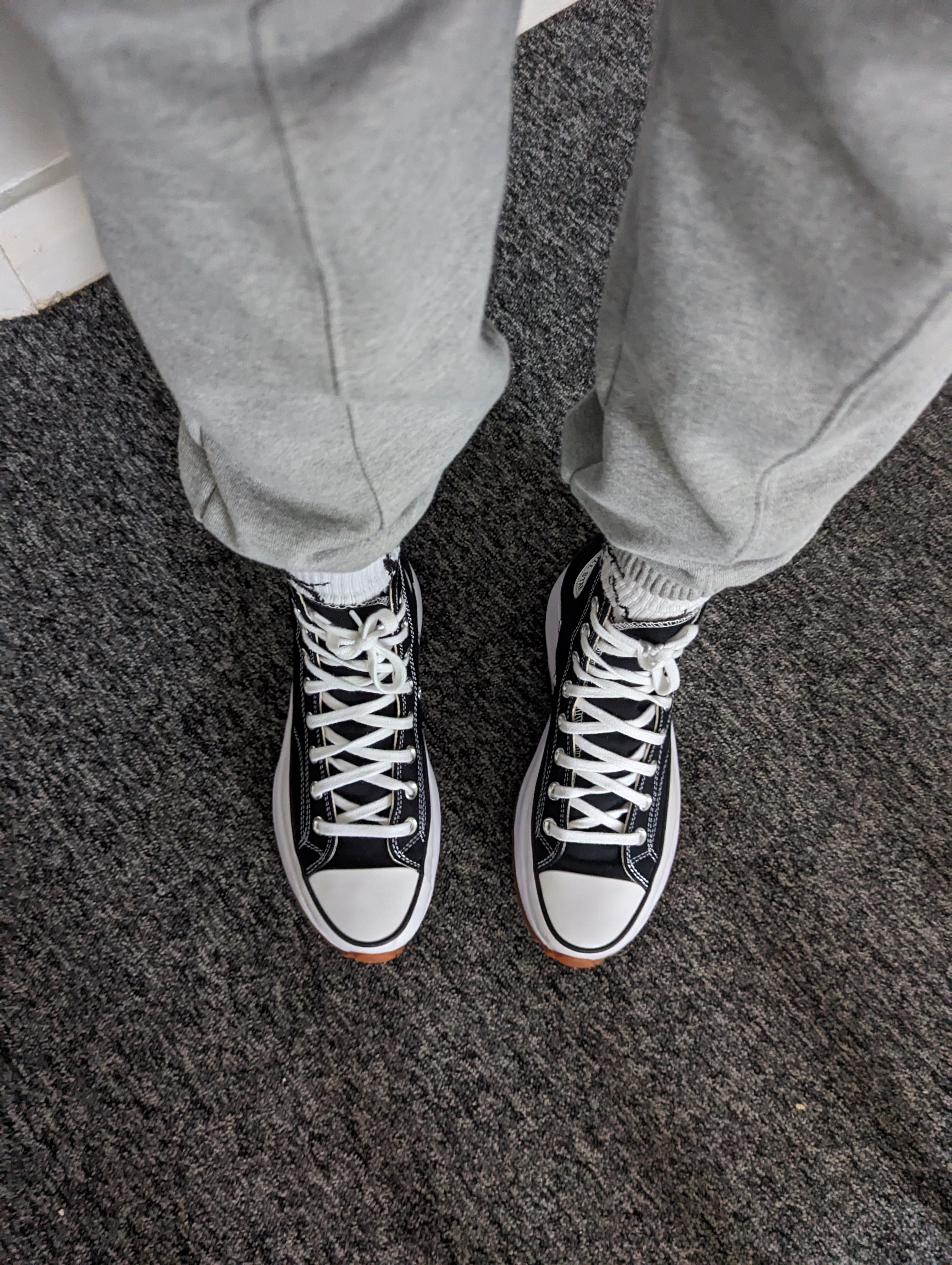
Peep the shoelace. It will come undone in T-40 minutes, give or take.
I am not incompetent because I cannot tie my shoelaces properly (okay, maybe a little). I am not less of an adult because other people learned or experienced things before I did (again, this is open for debate), but you get the gist.
Some people got their diplomas early. I am still collecting mine and I am less embarrassed about it now. I can learn. I can ask someone to show me. In fact, I have been discreetly observing Daan tie his (which he’ll now find out). I can practice until my fingers finally understand what everyone else seems to have known instinctively.
As I write this, I realize I need to follow up on the email I sent to the swimming school, and swimming classes are just the tip of the iceberg of things I am learning or trying to do. For example, camping, though I promise not to do it alone the way I do my hikes.
As I wrap this up and look forward to the next things I will learn in my adulthood, I have realized that the most important thing that differentiates me from my younger self is my consciousness. The admittance, disagreement and acceptance of who I am, who I will be, and who I will never be. The acknowledgment of what I have, what is missing, what I can gain, and what is lost forever. The realization of what I missed, deciding what still matters to me, and finally taking the steps to learn it, late as it may be.
I still have plenty of diplomas I haven’t received, but I suppose I have the rest of my life to collect them.